


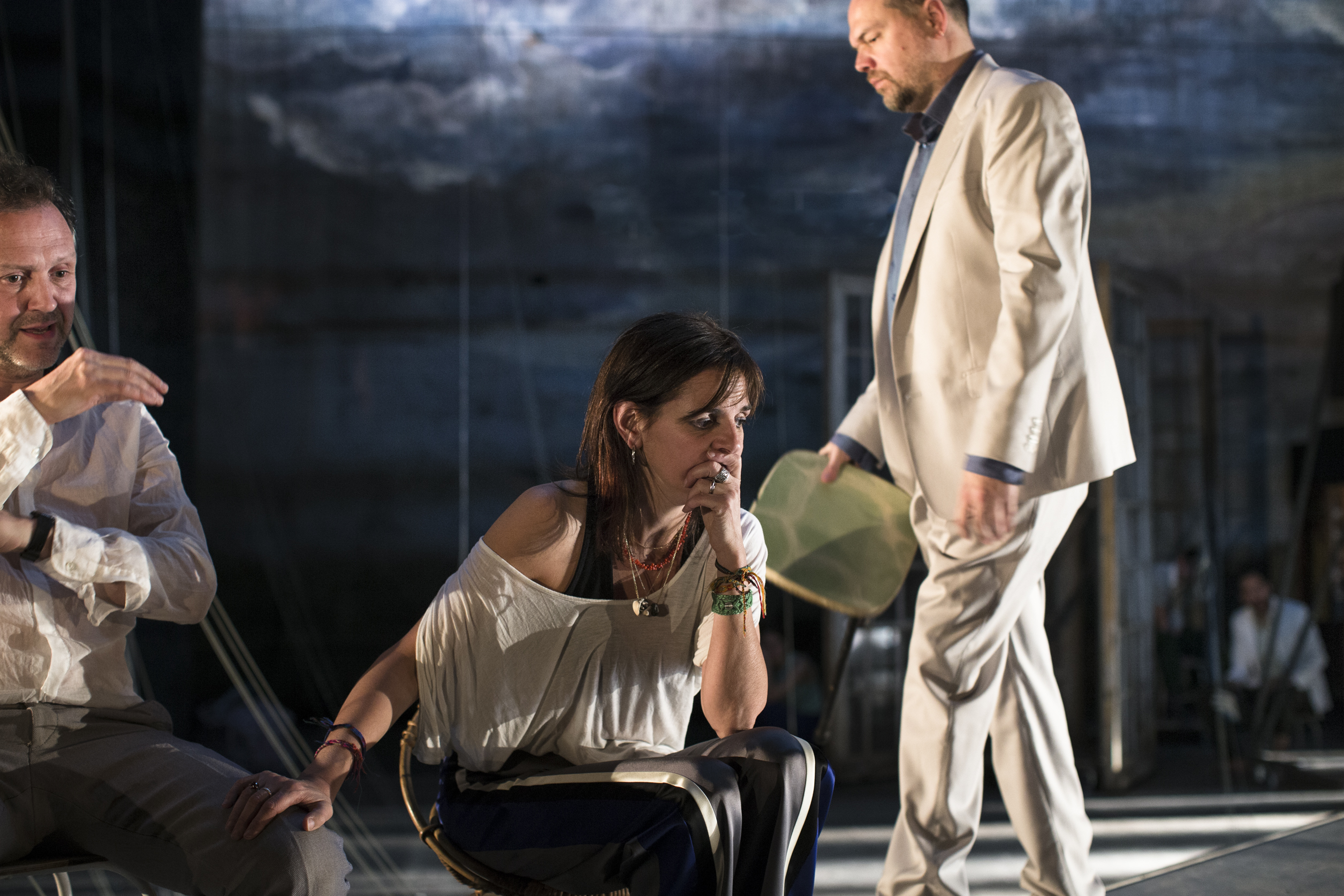
1-4 © Koen Broos
The next play I write will definitely be funny, very funny, at least in intention. (Chekhov to Olga Knipper, 7 March 1901)
Chekhov worked on The Cherry Orchard for years, ponderously, hesitantly, changing tone, all the while struggling with his health. He had been suffering from chronic tuberculosis for years and was now in rapid decline, often too tired to go on writing. On 28 July 1903 he wrote to Konstantin Stanislavski from his dacha in Yalta on the Crimean peninsula: “My play isn’t ready yet, it is progressing slowly, which can only be explained by my laziness, by the wonderful weather, and by the difficulty of the subject.” At the Moscow Art Theatre the manuscript was awaited with impatience, excitement, and anxiety, and on 27 September, Chekhov wrote to his wife, Olga Knipper: “My dear horsey, I have already wired to say that the play is ready, that all four acts are complete. I am now making a fair copy. I have managed to make them living people, but what the actual play is like, I don’t know.” And on 15 October: “Play sent. Healthy. Kiss. Regards, Antonio.” The manuscript was ecstatically received in Moscow. On 19 October, Olga wrote: “What a thrilling day yesterday, my darling, my beloved! I couldn’t write to you, my head was fit to burst. I had been expecting the play for two days and was becoming incensed that it had not arrived. Finally, yesterday morning it was brought to me. (…) When I had finished reading it, I ran to the theatre. Fortunately, the rehearsal had been cancelled. (…) If you had seen the faces of all those people bent over The Cherry Orchard! Naturally, everyone insisted on reading it aloud at once. We locked the door, removed the key, and began. The Cherry Orchard would eventually premiere on 17 January 1904. It would be Chekhov’s last play. He died a few months later, on 4 July 1904 …
In The Cherry Orchard, all the elements of a typical Chekhov play are present: a continuous movement of characters, a tempo and intensity that constantly change; dialogues that randomly appear and are unrelated, abruptly interrupted by seemingly irrelevant interventions or information; important data or feelings that are shared almost without notice; the elegance of the details; the economy of words. Chekhov remains the master of the economic expression, the open structure, a dramatic field rather than a dramatic line, no exaggerated emotions, no boasting, no important truths. The truth in this piece is modest, simple, indirect; it is rooted in the familiar rhythms of our lives. Nothing is inflated, the proportions are familiar, and yet everything is transformed, thanks to an imagination that allows us to penetrate deeply into the strangeness of the everyday. A True Comedy of High Seriousness, as American writer Richard Gilman called it.
Chekhov’s method is often compared to that of a composer or a painter: a brushstroke here, another one there, extend this line, a sudden spot, the gradual filling-in of an area, marks, blemishes, dark and light, rubbing out, building up, … on 11 May 1889 he wrote in a letter to his brother Alexander: “Drastic rewriting need not unsettle you, as the more of a mosaic the result is, the better. Thus, a dramatic field. “And yet, however many attempts have been made to understand the play, The Cherry Orchard remains an enigma and Chekhov cannot be pigeonholed. Since the beginning of its performance history, this play has been torn between interpretive polarities: naturalism or poetry, realism or symbolism, social lament or prophecy, comedy or tragedy. Not infrequently motivated by ideological short-sightedness, the play has already been called everything: a political indictment, a poetic-melancholic image of time, a nostalgic contemplation, an ode to progress, a social satire. The characters are constantly, depending on what emerges, favouring some ideology or another. Is Lopakhin now a hero who stands for progress and company affiliation? Or is he an upstart peasant with no manners, blinded by profit? Is Lyubov a spoiled and selfish brat who represents the past glory of the old landed gentry and could better perish with her entire clique as swiftly as possible? Or is she a sensual and irresistible ode to fragile humanity and the essential uselessness of our lives? Does she stand as a symbol for the right to that uselessness, for the right to beauty, to everything that has no economic value, to culture? Is Trofimov an enlightened spirit or a verbose wiseacre who is also idle? Or could it perhaps be that moral judgments are not addressed? Does Chekhov make his own mind known through his characters? Or does he just let them speak? Are the opinions those characters share with us also the themes of the play? Or are they just opinions that are expressed in the play? Could it be that the many layers of human activity are simply displayed in all their complexity? That the play does not completely reveal all his secrets, that the characters will not explain to us why they do what they do?
Chekhov is no doubt fondly chuckling in his grave and whispering softly in our ear: “All this, and everything else, or not. Find out for yourself.” It is certainly clear that this play is as elusive as life itself. In 1904, Russian poet Andrei Bely wrote in an essay on The Cherry Orchard that he doesn’t identify Chekhov’s method as a technical instrument, but rather speaks of what we ourselves might call his ‘glance’, as it falls with unparalleled clarity on the most minute particulars, on the extreme momentariness of our experience. It’s this approach toward the humble, the casual and fragmentary, the scorned, the very basis of the revolution Chekhov brought about in the theatre which sets free the previously unknown, what we might call the music that hasn’t yet been heard. An instant of life taken by itself as it is deeply probed becomes a doorway to infinity. The minutiae of life will appear ever more clearly to be the guides to Eternity. (…) In The Cherry Orchard, Chekhov draws back the folds of life and what at a distance appeared to be shadowy folds turns out to be an aperture into Eternity.*
Anton Pavlovich Chekhov has left an indelible stamp on the history of theatre, and his prose, letters, and plays are still among the finest in world literature. His grasp of man’s innermost feelings is unparalleled, his insight into human behaviour unequalled. He was a moral revolutionary; he has taught us to look at people as they are, big and small, strong and weak, good and bad, corrupt and grand he remains master of the drama of the undramatic, and will forever belong to that small group of authors who are essential to our quest as human beings, whose perspicacity can continue to help us preserve or recover our individual and collective mental health.
So why The Cherry Orchard in 2022? That is why or that is why… or that is why or…
* Chekhov’s plays: An Opening Into Eternity, by Richard Gilman. This entire text is indebted to Richard Gilman.


1-2 © Koen Broos
To Olga Knipper on 20 April 1904:
You ask: What is life? You might as well ask: What is a carrot? A carrot is a carrot, and we know nothing more
In French
text Anton Chekhov
by and with Evelien Bosmans, Evgenia Brendes, Robby Cleiren, Jolente De Keersmaeker, Lukas De Wolf, Bert Haelvoet, Minke Kruyver, Scarlet Tummers, Stijn Van Opstal and Frank Vercruyssen
lighting Thomas Walgrave
costumes An d’Huys
production and technique STAN
coproduction Kunstenfestivaldesarts, Festival d’Automne (Paris), Théâtre de la Colline (Paris), TnBA (Bordeaux), Le Bateau Feu (Dunkerque), Théâtre Garonne (Toulouse), Théâtre de Nîmes and STAN
premiere 14 May 2015, Kunstenfestivaldesarts l Théâtre Varia, Brussels
Project co-produced by NXTSTP, with the support of the European Union’s Culture Programme
“In the version by tg STAN, the dynamic collective from Antwerp, Jolente De Keersmaeker plays this role with a constant energy. With a supple dancing body and with cheeky, tender or guttural words, she easily changes emotions. She impresses her counterparts and leads the dance, literally and figuratively, to the extent that the desire to move seems like an outlet for the insecurities in her life. The strength of this performance is that it strips Chekhov’s masterpiece of its usual melancholic gloom. Life pulses through it, like laughter, a joke or even magic, in the dreamy shade of the white cherry orchard.”
Télérama, 03/05/2023
2025
2023
may
2019
January
Sat 12.01.19 20:30
La Mouche
Saint-Genis-Laval
Sun 13.01.19 15:30
La Mouche
Saint-Genis-Laval
Tue 15.01.19 20:00
Le Manège
Maubeuge
Sat 19.01.19 20:30
Théâtre de Saint-Quentin-en-Yvelines
Saint-Quentin-en-Yvelines
Sun 20.01.19 16:00
Théâtre de Saint-Quentin-en-Yvelines
Saint-Quentin-en-Yvelines
2018
April
Wed 11.04.18 19:30
National Arts Centre
Ottawa
Thu 12.04.18 19:30
National Arts Centre
Ottawa
Fri 13.04.18 19:30
National Arts Centre
Ottawa
Sat 14.04.18 19:30
National Arts Centre
Ottawa
2017
october
Fri 06.10.17 20:30
la Comédie de Reims
Reims
Sat 07.10.17 18:30
la Comédie de Reims
Reims
Sun 08.10.17 15:30
la Comédie de Reims
Reims
2015
september
Thu 17.09.15 20:00
ZKM - Zagreb Youth Theatre
Zagreb
Fri 18.09.15 20:00
ZKM - Zagreb Youth Theatre
Zagreb
Thu 24.09.15 20:00
Théâtre Garonne
Toulouse
Fri 25.09.15 20:30
Théâtre Garonne
Toulouse
Sat 26.09.15 20:30
Théâtre Garonne
Toulouse
Wed 30.09.15 20:00
Théâtre Garonne
Toulouse
october
Thu 01.10.15 20:00
Théâtre Garonne
Toulouse
Fri 02.10.15 20:30
Théâtre Garonne
Toulouse
Wed 14.10.15
Le Maillon
Strasbourg
Thu 15.10.15
Le Maillon
Strasbourg
Fri 16.10.15
Le Maillon
Strasbourg
november
Tue 03.11.15 20:00
Théâtre de Nimes
Nîmes
Wed 04.11.15 19:00
Théâtre de Nimes
Nîmes
Fri 06.11.15
Bois de l’Aune
Aix-en-Provence
Sat 07.11.15
Bois de l’Aune
Aix-en-Provence
Sun 08.11.15
Bois de l’Aune
Aix-en-Provence
Tue 10.11.15
Le Parvis
Tarbes
Thu 12.11.15
Théâtre national de Bordeaux en Aquitaine
Bordeaux
Fri 13.11.15
Théâtre national de Bordeaux en Aquitaine
Bordeaux
Sat 14.11.15
Théâtre national de Bordeaux en Aquitaine
Bordeaux
Tue 17.11.15
Théâtre national de Bordeaux en Aquitaine
Bordeaux
Wed 18.11.15
Théâtre national de Bordeaux en Aquitaine
Bordeaux
Thu 19.11.15
Théâtre national de Bordeaux en Aquitaine
Bordeaux
Fri 20.11.15
Théâtre national de Bordeaux en Aquitaine
Bordeaux
Sat 21.11.15
Théâtre national de Bordeaux en Aquitaine
Bordeaux
Mon 23.11.15
Le Lieu Unique
Nantes
Tue 24.11.15
Le Lieu Unique
Nantes
Thu 26.11.15
Le Bateau Feu
Dunkerque
Fri 27.11.15
Le Bateau Feu
Dunkerque
december
Wed 02.12.15 20:30
La Colline
Paris
Thu 03.12.15 20:30
La Colline
Paris
Fri 04.12.15 20:30
La Colline
Paris
Sat 05.12.15 20:30
La Colline
Paris
Sun 06.12.15 15:30
La Colline
Paris
Wed 09.12.15 20:30
La Colline
Paris
Thu 10.12.15 20:30
La Colline
Paris
Sat 12.12.15 20:30
La Colline
Paris
Tue 15.12.15 19:30
La Colline
Paris
Wed 16.12.15 20:30
La Colline
Paris
Thu 17.12.15 20:30
La Colline
Paris
Fri 18.12.15 20:30
La Colline
Paris
Sat 19.12.15 20:30
La Colline
Paris
Sun 20.12.15 15:00
La Colline
Paris